How to Buy IPOs in Canada: Which Platform Is Best
To buy IPOs in Canada you have two routes: request shares at the offer price before trading starts, or buy on the first day a stock lists. Wealthsimple IPO Access is the easiest offer-price route for everyday investors, with no minimum and no fee. Bank desks and Questrade offer more, with strings attached.
How do IPOs work in Canada?
An initial public offering (IPO) is the first time a private company sells shares to the public. The shares are sold in the primary market through a syndicate of underwriters, usually investment banks, before the stock lists and trades freely in the secondary market. Most of an IPO is allocated to institutional buyers, with a slice passed to the underwriters' retail brokerages. That structure is why retail investors were historically locked out of the offer price. To get shares at the IPO price you needed an account at a brokerage in the selling group, and even then an allocation was never guaranteed. You submit an expression of interest or a conditional bid, and you receive a full fill, a partial fill, or nothing, depending on demand. The alternative has always been open to everyone: wait for the stock to list, then buy it on the exchange like any other share. The catch is that you pay the market price, not the offer price, and a hot IPO can open well above where it was priced.
What are the two ways to buy an IPO in Canada?
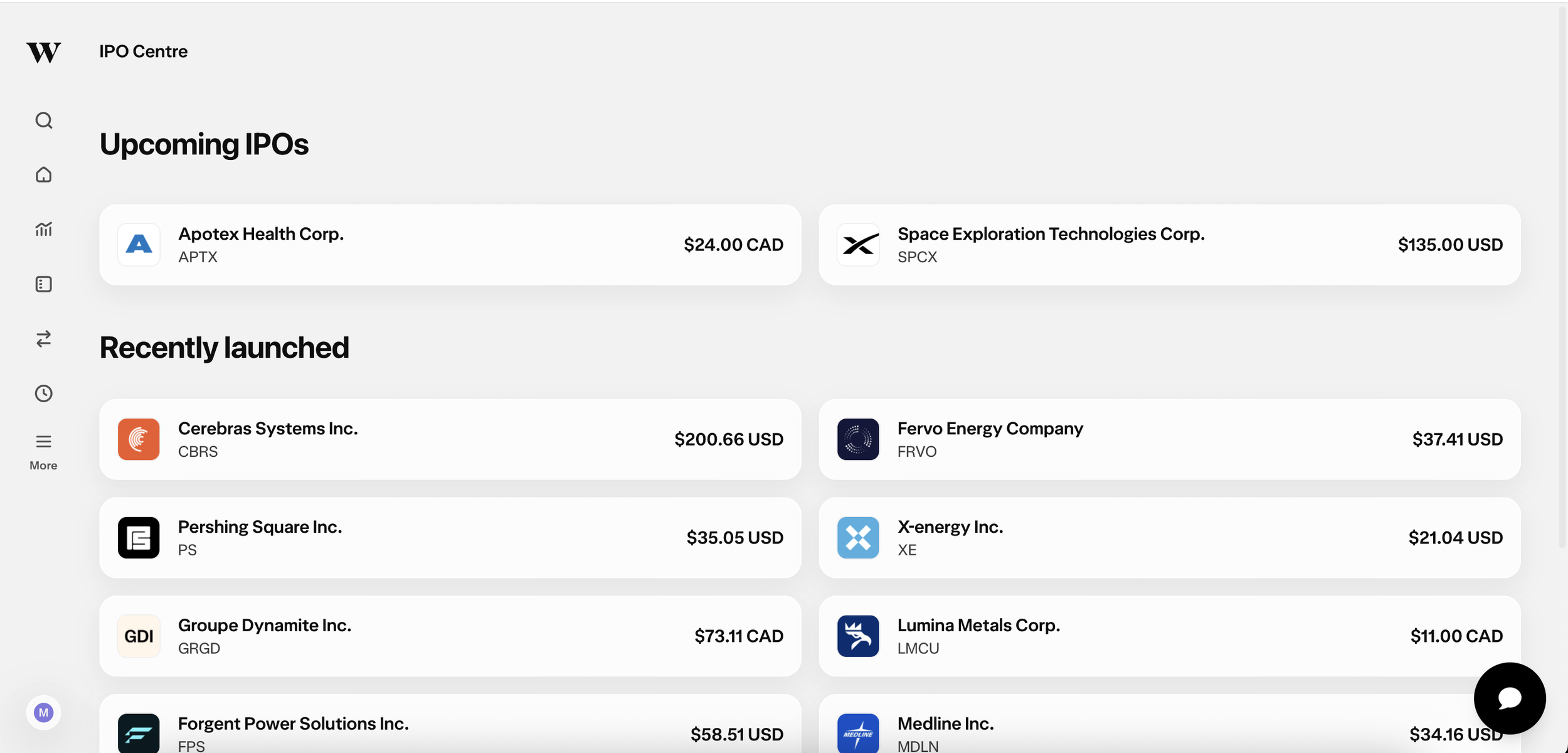
There are two distinct paths, and the best platform depends on which one you want. The first is offer-price access: requesting shares before the stock starts trading, at the price institutions pay. This is the route that was hard for retail investors to reach. It now runs through Wealthsimple IPO Access, the bank new issue desks, and Questrade's IPO Centre. The second is first-day trading: buying the stock the moment it lists. Any Canadian brokerage can do this, and platforms with strong order types and extended-hours access, such as Interactive Brokers, give you the most control. You buy at the market price, with no allocation lottery and no minimums.
How does Wealthsimple IPO Access work?
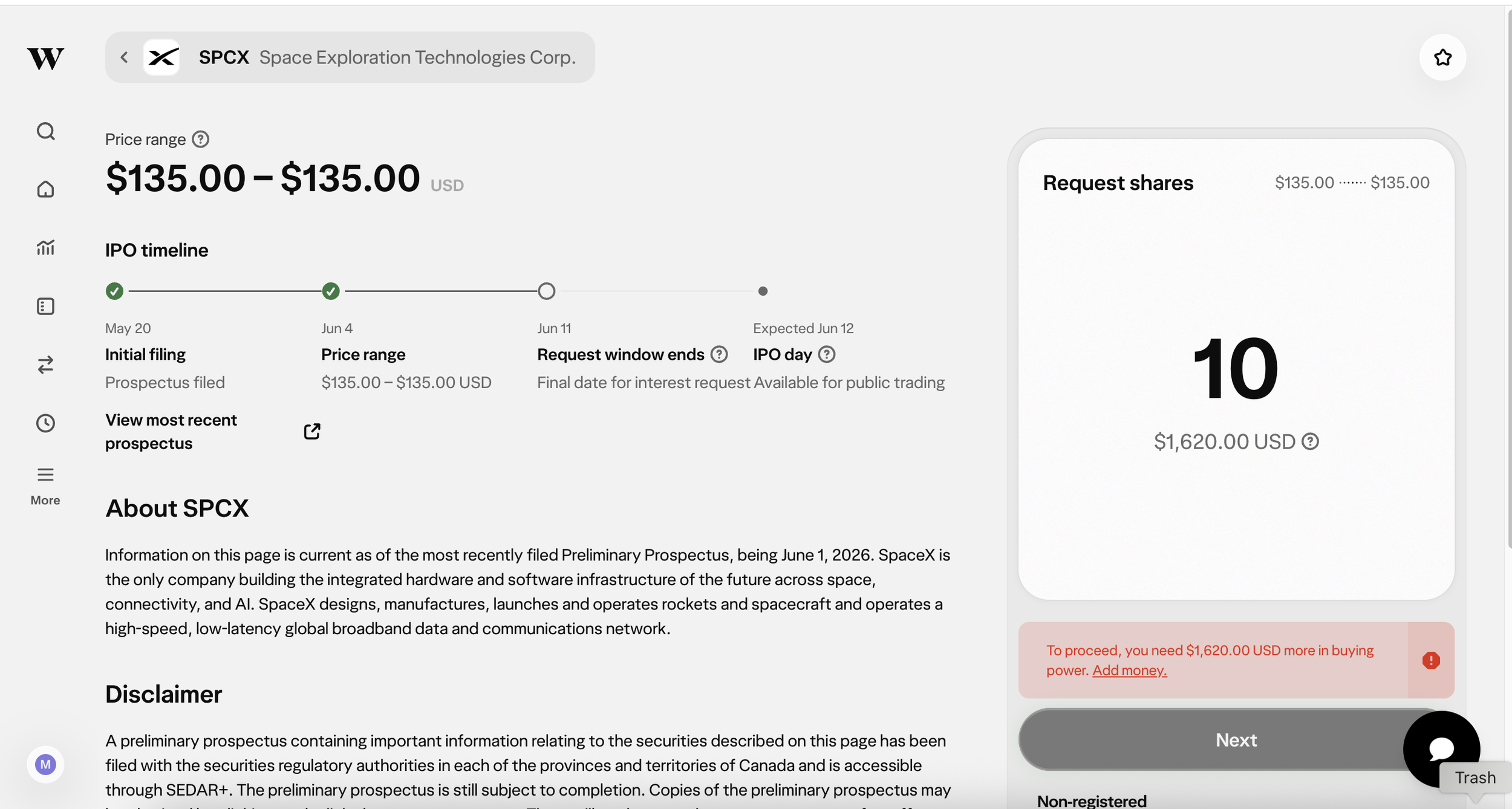
Wealthsimple launched IPO Access in May 2026, and it is the most accessible offer-price route for ordinary investors. Eligible clients can request shares in select Canadian and US IPOs at the offering price, with no minimum order and no fee to participate. You can request a single share. Wealthsimple is not the underwriter. It participates as a selling group member, meaning investment banks allocate a block of shares to Wealthsimple, which passes them to clients. Because of that, timing details such as when bidding closes and when shares are priced are set by the syndicate and can change with little warning. When an offering is oversubscribed, allocation runs in two steps. First a randomized selection decides who gets any shares at all, with every eligible request treated equally regardless of size or account history. Then the size of your request affects how many shares you receive, but not your odds of being selected. You find out your allocation on the day of the IPO. One rule to know: selling or transferring your allocated shares within 90 days is treated as flipping, and Wealthsimple's current policy is to restrict flippers from future IPOs. If you want offer-price access to be a repeatable thing, plan to hold. See our Wealthsimple review for how the wider platform stacks up.
How do bank and independent new issue desks handle IPOs?
This is not a niche route. All five big bank brokerages run new issue desks, and so does the independent Qtrade, so offer-price access to Canadian new issues is widely available, not a rare feature. TD Direct Investing is a clear example: its New Issues Centre in WebBroker handles hundreds of new issues a year, and you place an expression of interest online or by phone, with the same fill priority either way. The mechanics are consistent across these desks. There is no commission to participate. You express interest, the allocation is at the brokerage's discretion, and you can receive a full, partial, or zero fill. At TD the minimum for an equity new issue is generally one board lot, about 100 shares, while fixed income new issues start at $5,000 face value. RBC Direct Investing offers the same kind of no-commission, expression-of-interest access, as do BMO InvestorLine, CIBC Investor's Edge, and Scotia iTRADE. Qtrade provides the same through the New Issues section of its platform; our Qtrade review covers where it lands overall. The trade-off is that these desks lean toward Canadian issues and a slate of preferred shares, trust units, and bonds, rather than the headline US technology listings retail investors tend to chase. They are strong for breadth of Canadian new issues, weaker for the buzzy names.
What does Questrade offer, including pre-IPO access?
Questrade has offered launch-day IPO access since 2013 through its IPO Centre, where you can request select Canadian IPOs and other new issues such as secondary offerings and corporate bonds. You need a self-directed account, and the practical catch is the buy-in: Questrade has generally required a commitment of at least $5,000 in the security to participate, a meaningfully higher bar than Wealthsimple's no-minimum model. Questrade has also announced a private markets platform, expected to launch in summer 2026, that goes a step earlier than an IPO. It is designed to let investors buy into companies while they are still private, months before any public listing, alongside institutional-grade private credit. This is not open to everyone. It is restricted to accredited investors, and Questrade has said it is lowering barriers within that group rather than removing the accredited requirement. If pre-IPO investing is the appeal, that platform is the differentiator, but treat any position as illiquid and high-risk. Our Questrade review covers the core trading platform in detail.
Can you buy US IPOs in Canada at the offer price?
Mostly no, and the reason is regulatory. To market a new issue to Canadian residents, a company generally has to file a prospectus in Canada. Most US and international companies do not, so their IPOs are not available to Canadians at the offer price. You can still buy them once they list and trade. Wealthsimple is the notable widening of this door. It can offer US IPOs that are brought into Canada by prospectus to all eligible clients. For US-only offerings that are not registered into Canada, securities law limits access to accredited investors, so most retail clients are excluded from those specific deals. To qualify as an accredited investor in Canada, an individual generally needs financial assets (cash and securities, net of related liabilities) above $1 million, or net income before tax above $200,000 in each of the last two years ($300,000 combined with a spouse) with a reasonable expectation of the same this year. These thresholds also gate Questrade's coming private markets platform.
What about Interactive Brokers and buying at the open?
Interactive Brokers is the platform to beat if your plan is to buy on the first day of trading rather than chase an allocation. Its order types, low costs, and extended-hours access give you precise control over how and when you buy a freshly listed stock. What IBKR does not reliably offer Canadian retail clients is an offer-price IPO allocation. Its IPO subscription tool is limited to certain entities outside Canada, and the firm has stated it generally does not give clients access to US company IPOs. For most Canadians, IBKR is a first-day-of-trading tool, not an offer-price one. See our Interactive Brokers review for the full picture.
Are IPOs actually a good investment?
Getting in at the offer price feels like an edge, but the data is sobering. A 2025 academic study found that IPO products offering shares to retail investors at the institutional price underperformed comparable offerings that were not retail-accessible by roughly 20 percentage points over their first year as public companies. The researchers tied the gap to aggressive pricing and attention-driven buying of names with online buzz. There are practical strings too. Allocations are usually partial or zero on the deals everyone wants, prices can be volatile on day one, and the flipping restrictions mean you cannot always sell quickly without consequences. An IPO in a sector where you already hold a lot can add concentration rather than improve diversification. None of that makes IPOs uninvestable. It means the smart question is whether you want to own the company for years, not whether you can land a hot allocation. If you are buying only for the pop, you are taking the side of the trade the evidence says tends to lose.
Which platform is best for buying IPOs in Canada?
It depends on what you actually want. For the lowest barrier to offer-price shares, Wealthsimple IPO Access wins outright: no minimum, no fee, the broadest retail eligibility, and access to US-into-Canada deals. For breadth of Canadian new issues, including preferred shares and fixed income, a bank desk such as TD or RBC is stronger. For pre-IPO and private market exposure, Questrade's accredited-only platform is the only one of these aiming squarely at that, though its public IPO Centre carries a higher buy-in. For buying cleanly on listing day, Interactive Brokers gives you the most control. If you are weighing platforms on more than IPO access, our guide to choosing a Canadian online broker and the full side-by-side broker comparison lay out fees, platforms, and account types. Check current promotions before you open anything, since sign-up offers move quickly.
The bottom line
If you are an ordinary Canadian investor who wants a real shot at offer-price IPO shares, open Wealthsimple IPO Access and treat it as a hold, not a flip. If you want depth of Canadian new issues, add a bank brokerage. If you are an accredited investor chasing pre-IPO exposure, Questrade is the one building for you, with eyes open to the illiquidity. And if your edge is execution on listing day, use Interactive Brokers and skip the allocation lottery entirely. Whatever route you pick, decide whether you want to own the business before you decide you want the trade. Broker Guide Canada may earn a commission through affiliate links. This does not influence our editorial rankings. See our full disclosure.
FAQs
Can I buy an IPO at the offer price in Canada?
Yes, through a brokerage in the selling group. Wealthsimple IPO Access, the bank new issue desks, and Questrade's IPO Centre all let eligible clients request shares before trading begins. An allocation is never guaranteed, and it is often partial or zero on popular deals.
Is there a minimum to participate in an IPO?
It varies by platform. Wealthsimple has no minimum and lets you request a single share. Bank desks such as TD generally require one board lot, about 100 shares, for equities, and Questrade has typically required a commitment of at least $5,000.
Can Canadians buy US IPOs like SpaceX at the offer price?
Only when the company files a prospectus in Canada, which brings the deal into reach for eligible clients. US-only IPOs that are not registered in Canada are limited to accredited investors. Otherwise you can buy the shares once they start trading on the exchange.
What is the Wealthsimple IPO flipping rule?
Selling or transferring your allocated shares within 90 days is treated as flipping, and Wealthsimple's current policy restricts flippers from future IPO Access offerings. If you want repeat access, plan to hold beyond that window.
Do I pay a commission to participate in an IPO?
No. Wealthsimple, the bank new issue desks, and Questrade's IPO Centre do not charge a fee or commission to participate in a new issue. You pay only the offering price for any shares you are allocated.
What is pre-IPO investing and who can do it?
Pre-IPO investing means buying into a company while it is still private, before any public listing. In Canada it is generally restricted to accredited investors. Questrade has announced a private markets platform for this, expected in summer 2026.
