Best Online Broker for Beginners in Canada (2026)
Wealthsimple is the best online broker for most beginners in Canada. $0 commissions, fractional shares from $1, an app that's genuinely well-designed, and account opening in under 10 minutes. But "best for beginners" isn't a single answer — it depends on whether you're a student, how much you're investing, whether you'll want to grow into more advanced features, and how much you care about currency conversion costs. This guide breaks down the top beginner-friendly options and explains what actually matters when you're choosing your first broker.
What Should a Beginner Look For in a Broker?
Here's what actually matters when you're making your first trade — ranked by how much each factor affects a beginner's experience.
1. Zero trading commissions. This is non-negotiable in 2026. If you're paying $9.95 per trade at a Big Bank broker, every small purchase eats a disproportionate chunk of your investment. On a $200 ETF buy, a $9.95 commission is a 5% drag. Five brokers now offer $0 commissions in Canada: Wealthsimple, Questrade, Qtrade, NBDB, and Webull. There's no reason to pay trading fees as a beginner.
2. No account fees or minimums. You shouldn't need $5,000 or $25,000 to avoid quarterly maintenance charges. Big Bank brokers charge $25/quarter or $100/year unless you hit balance thresholds — a penalty for being new to investing. Every independent broker has eliminated these fees.
3. A platform you can actually use. This sounds subjective, but it's the single biggest determinant of whether a new investor sticks with it. If the app is confusing, cluttered, or requires you to learn jargon before you can place an order, you'll stop using it. Simplicity isn't a feature for beginners — it's the feature.
4. Fractional shares. If you have $100 to invest and the ETF you want trades at $115 per unit, you can't buy it without fractional share support. This matters enormously for small, regular contributions — which is exactly how most beginners invest.
5. Registered account support. Your first brokerage account should almost certainly be a TFSA. Make sure the broker offers it (they all do), but also check whether they support FHSA (if you're saving for a first home) and RRSP (for retirement). If you'll need an RESP or RDSP later, note which brokers don't offer them.
What Beginners Should Not Worry About
Equally important: things that dominate broker comparison articles but are irrelevant when you're starting out.
Margin rates. You shouldn't be borrowing money to invest when you're learning. Margin is for experienced investors with a clear strategy. Ignore it.
Options fees. Same logic. Options are a powerful tool for people who understand them and a fast way to lose money for people who don't. You'll get there eventually — or you won't, and that's fine too.
FX conversion costs. Yes, currency conversion spreads matter when buying US stocks. But if you're investing $200/month into a Canadian-listed ETF like XEQT or VEQT, you're not converting currency at all. FX costs become relevant when your portfolio grows and you start buying US-listed securities directly. Don't let it drive your first broker choice.
Advanced research tools. Screeners, Level 2 data, analyst reports, TradingView integrations — these are meaningful for active traders. If you're buying one or two ETFs per month in your TFSA, you don't need any of this. A Google search and a Morningstar fund page will serve you better than a built-in screener you'll never open.
For a full breakdown of all canadian brokers across every category, see our comparison table.
Wealthsimple: Best Overall for Beginners
Wealthsimple is the default recommendation for anyone opening their first brokerage account in Canada, and it's not particularly close.
Why it wins for beginners:
The app is the most polished in Canadian investing. Account opening takes under 10 minutes with instant ID verification. Instant deposits up to $50K mean you can fund your account and buy your first ETF in a single sitting. Fractional shares let you invest any dollar amount — $25 into XEQT, $50 into Shopify — without worrying about share prices. Commissions are $0 on everything: stocks, ETFs, and options.
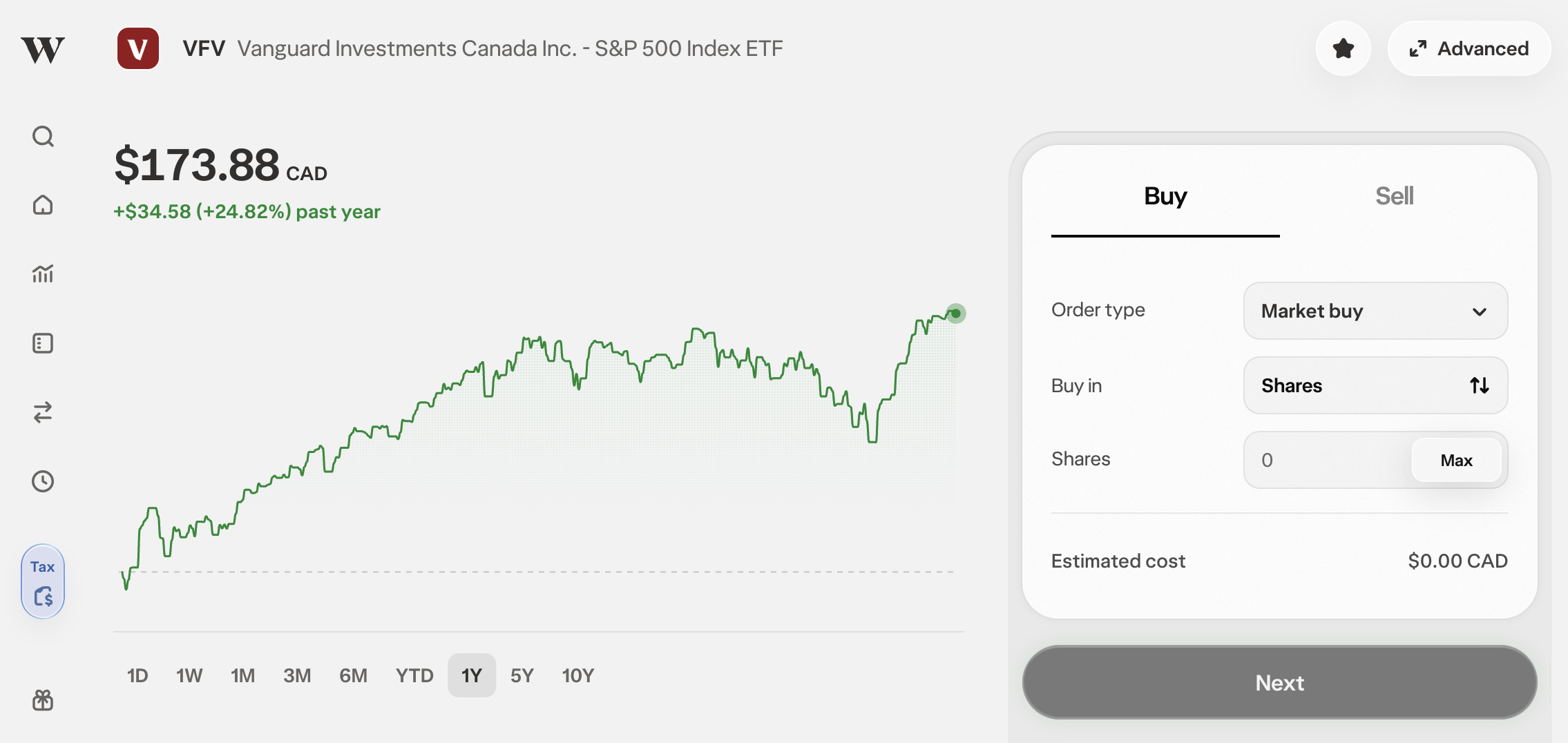
Wealthsimple app preview.
Wealthsimple also doubles as a bank. You can hold a chequing account, savings account, and investment accounts all in one app. For a beginner who wants to see their entire financial picture in one place, this integration is a genuine advantage.
Where it falls short:
Research tools are minimal. There's no meaningful screener, no analyst reports, and charting is basic (though improved with a recent TradingView integration). If you eventually want to do deeper analysis, you'll need to look elsewhere — or use free external tools.
The FX spread is 1.5% on the Core tier for USD trades. This doesn't matter if you're buying Canadian-listed ETFs, but it adds up fast if you start buying US stocks directly. The spread drops to 0.05% at the Premium tier ($100K+ in assets), but beginners won't hit that threshold for a while.
Best for: First-time investors, small regular contributions, anyone who values simplicity above everything else.
Read our full Wealthsimple review for the complete picture, or see how it stacks up in our Questrade vs Wealthsimple comparison.
Questrade: Best for Beginners Who Want to Grow
Questrade is the pick for a beginner who suspects they'll want more from their broker within a year or two.
Why it works for beginners:
$0 commissions on stocks and ETFs since February 2025. No account minimums (the old $1,000 requirement was removed). No inactivity or maintenance fees. The QuestMobile app is clean and functional — not as elegant as Wealthsimple, but perfectly usable for a new investor.
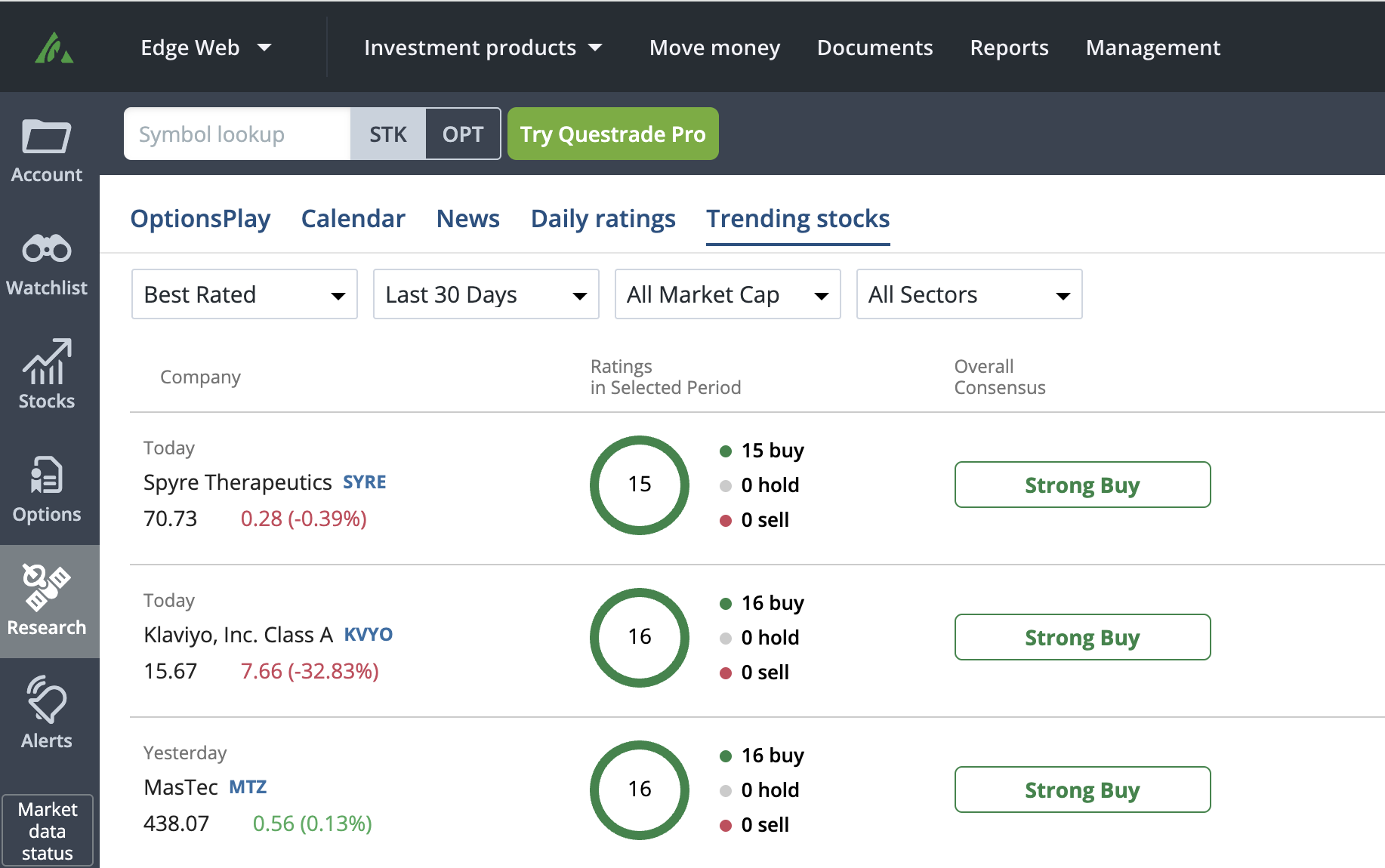
Questrade app preview.
What separates Questrade is what's waiting for you when you grow. TipRanks and Seeking Alpha are integrated for research. Questrade Pro offers advanced charting when you're ready for it. Norbert's Gambit is supported with free online journaling — the best FX cost workaround in Canada outside of IBKR. Dual-currency (CAD/USD) accounts are free across all registered types, which means no forced conversions when buying and selling US stocks.
Questrade covers 12 of 13 registered account types (everything except RDSP), so you're unlikely to outgrow it. And their customer support is consistently rated among the best in Canada — Surviscor ranked them #1 in 2026.
Where it falls short:
Fractional shares are US-listed only. If you want to buy $50 of a Canadian stock, you can't do it at Questrade (yet). The app isn't as visually refined as Wealthsimple's, though it's perfectly functional. And the Learning Centre, while comprehensive, is drier than Wealthsimple's editorial content.
Best for: Beginners who plan to hold US stocks, want room to grow into advanced tools, or value strong customer support.
Read our full Questrade review or see Questrade fees explained.
Qtrade: Best Platform Experience for New Investors
Qtrade is often overlooked in beginner conversations because it doesn't have Wealthsimple's brand awareness or Questrade's market share. That's a mistake.
Why it works for beginners:
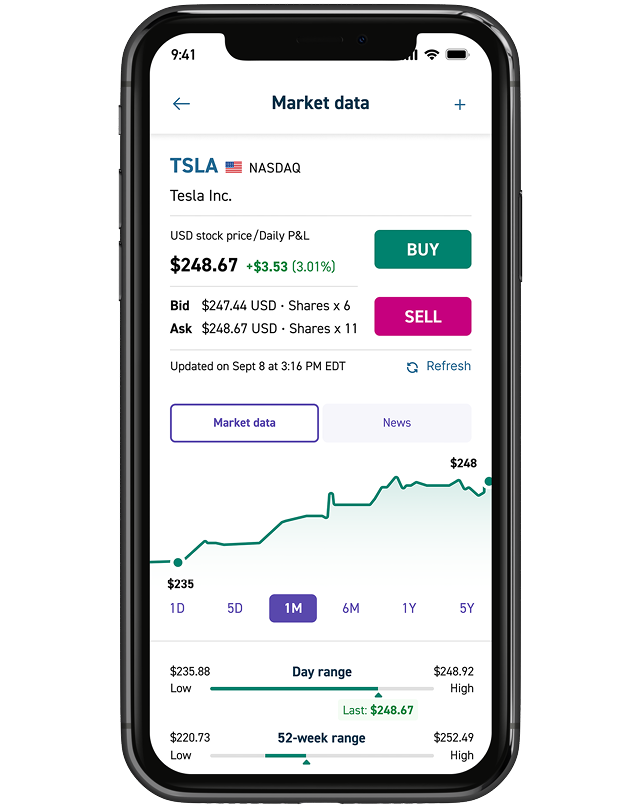
Qtrade app preview.
Qtrade's platform is genuinely excellent — modern, intuitive, and award-winning. They went commission-free on Canadian and US stocks and ETFs in October 2025, eliminating the fee disadvantage that previously kept them off beginner shortlists. The mobile app has won multiple design awards and is as clean as anything in the Canadian market.
Where Qtrade stands out is in its portfolio tools. Portfolio Score and Portfolio Simulator are built for investors who want to understand their holdings without needing a finance degree. Trading Central integration provides professional-grade research in an accessible format. For a beginner who wants guidance alongside self-directed investing, Qtrade hits a sweet spot.
Where it falls short:
No fractional share support. The FX spread is roughly 1.5–2%, in line with most competitors but far behind IBKR. Account types cover 10 of 13 (no LIF, Corporate, or RDSP). And the transfer-fee rebate requires a $15,000 minimum, which is higher than Questrade's no-minimum rebate.
Best for: Beginners who want an intuitive platform with strong portfolio analysis tools and don't need fractional shares.
Read our full Qtrade review or see our article on Qtrade vs Questrade.
NBDB: Best Bank Broker for Beginners
National Bank Direct Brokerage is the one Big Bank brokerage that can genuinely compete with the independents on fees.
Why it works for beginners:
NBDB was the first Big Bank broker to go commission-free, back in 2021. No trading fees on stocks or ETFs. Full registered account coverage (all 13 types including RDSP). $0 minimum deposit. If you want the regulatory comfort and institutional stability of a Big Six bank without paying Big Bank prices, NBDB is the only option that delivers.
The annual fee is $100, but it's waived at $20,000 in assets, with 5 or more trades per year, or if you're 30 and under — a meaningful carve-out for younger investors.
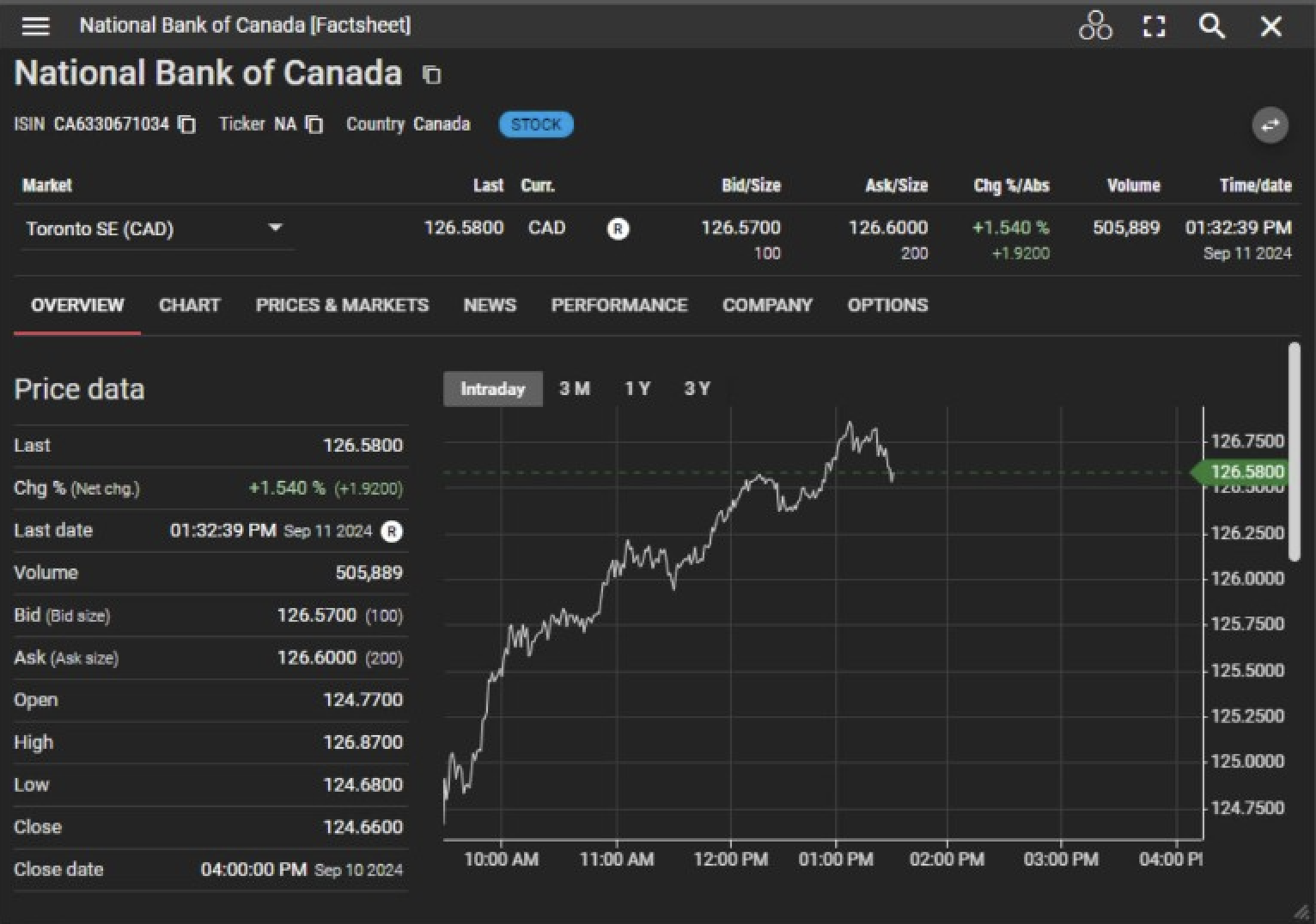
NBDB app preview.
Where it falls short:
The platform lags behind every independent broker. The interface has improved but still feels dated. No fractional shares. Research tools are adequate but not competitive with Questrade or Qtrade. Customer support has been a consistent pain point — long hold times and slow processing are common complaints. And the $135 transfer-out fee means leaving NBDB later isn't free.
Best for: Beginners who want to bank and invest at the same institution, with $0 trading fees and a preference for Big Bank infrastructure.
CIBC Investor's Edge: Best for Investors Under 25
CIBC Investor's Edge isn't a strong general recommendation, but it has one standout feature that matters for a specific group of beginners.
Why it works for young investors:
If you're 18–24 and hold a CIBC Smart Start chequing account, CIBC gives you $0 commissions on all North American stocks and ETFs and waives the $100 annual fee entirely — until you turn 25. Students (any age, with proof of full-time enrollment) get reduced trading at $5.95 per trade and a waived annual fee.
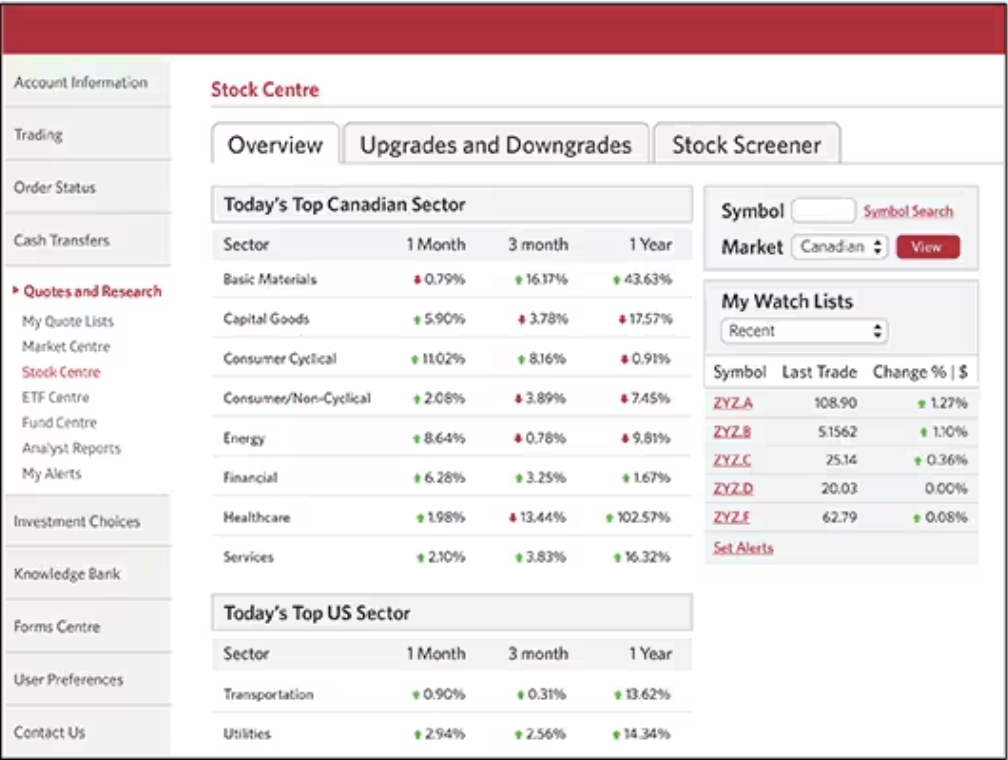
Investor’s Edge app preview.
This makes CIBC the cheapest possible setup for a young investor who already banks with CIBC. Full account type coverage (all 13 types including RDSP), USD accounts in registered plans, and the backing of a Big Five bank.
Why it's not the top pick overall:
Once you turn 25, the fee structure snaps back: $6.95 per trade (the lowest among Big Banks, but infinitely higher than $0 at the independents) and a $100 annual fee unless you maintain $10K+ in non-registered or $25K+ in RRSP. The mobile app is uninspiring. Research tools have improved but remain limited on mobile. And transferring out later costs $100 per account.
Best for: Canadian investors aged 18–24 who already have CIBC banking. Not recommended for anyone else.
What About Interactive Brokers?
Interactive Brokers is the most powerful brokerage platform available in Canada, but it’s not a great platform for beginners.
The interface is built for professional traders. The account opening process is longer and more involved than any competitor. The learning curve is steep enough that IBKR themselves publish extensive documentation just to explain the basics. If you're buying your first ETF, IBKR is like using a Bloomberg Terminal to check the weather.
That said: if you're a beginner with a large lump sum to invest (inheritance, home sale proceeds, significant savings), IBKR's near-zero FX conversion costs could save you hundreds of dollars compared to any other broker. And unlike most beginners, someone investing $100K+ on day one will care about margin rates and multi-currency account support from the start.
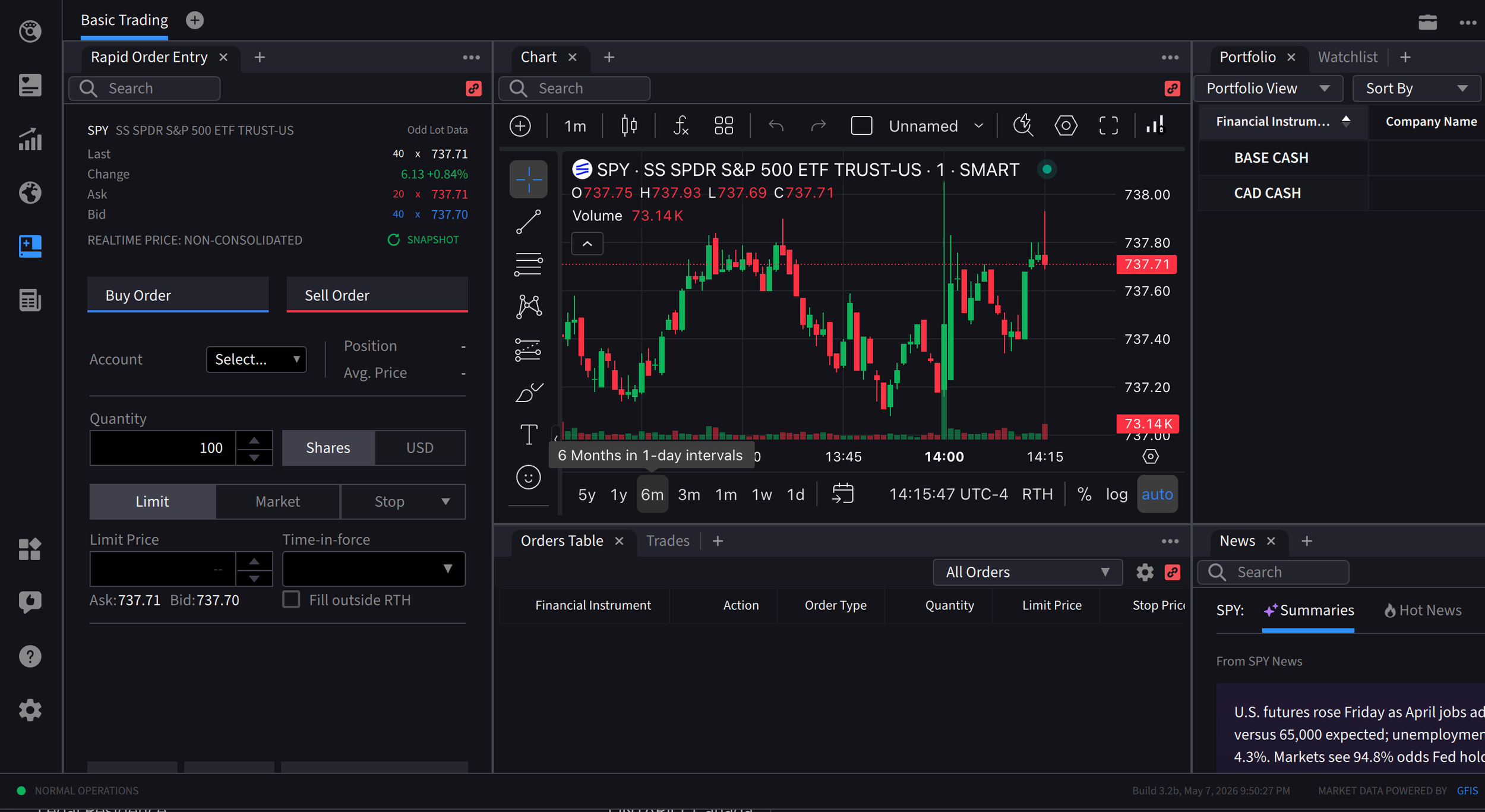
InteractiveBrokers Canada app preview.
Our take: Start somewhere simpler. Transfer to IBKR later if you outgrow your first broker. We explain this in our full IBKR review and IBKR fees breakdown. We also show you how to transfer accounts between brokerages in this article.
What About the Other Big Banks?
TD Direct Investing, BMO InvestorLine, RBC Direct Investing, and Scotia iTRADE all charge $9.95–$9.99 per trade. They all impose quarterly maintenance fees with balance minimums. They all lack fractional share support (TD has a limited partial implementation at $1.99 per trade). Their mobile apps range from decent (TD, BMO) to disappointing (Scotia).
The one argument for a Big Bank broker is convenience — if you already bank with TD, having your chequing and TFSA in one login is frictionless. TD also has the best educational resources among the banks, with detailed articles and video tutorials that rival the independent brokers.
But convenience isn't worth $9.95 per trade. If you're at a Big Bank and want to start investing, transfer your account to an independent broker. The receiving broker will reimburse the transfer-out fee. You'll save hundreds of dollars per year in commissions alone.
How to Open Your First Brokerage Account
Choose a broker. Wealthsimple for maximum simplicity. Questrade if you want room to grow. Qtrade for the best platform experience. CIBC if you're under 25 and already bank there.
Download the app or visit the website. Have your SIN, government ID, and banking information ready.
Open a TFSA first. Unless you have a specific reason to use an RRSP (employer match, high income, imminent home purchase via HBP), the TFSA is the right first account for most Canadians. Contributions aren't tax-deductible, but all growth and withdrawals are completely tax-free — forever.
Fund your account. Link your bank account and deposit whatever you're comfortable with. You can start with $1 at Wealthsimple.
Buy a broad-market ETF. If you don't have a specific investment thesis, an all-in-one ETF like XEQT (100% equities, global diversification) or VGRO (80% equities, 20% bonds) is a sound starting point. One purchase gives you exposure to thousands of companies across every major market.
Set up automatic contributions. Most brokers let you schedule recurring deposits. $50/week or $200/month into a single ETF is a perfectly valid investment strategy — and it's more effective than what most Canadians do with their savings.
How Much Money Do You Need to Start Investing?
Just start as soon as you can, with as much as you can afford to allocate. There is no true minimum, especially with a platform like Wealthsimple where you can deposit as little as $1 and trade fractional shares.
The “practical minimum” is whatever you can afford to set aside regularly without affecting your ability to cover expenses. $25/week is $1,300/year. In a TFSA earning an average 7% annually, that's roughly $18,000 after 10 years. Starting small and staying consistent beats waiting until you have a "real" amount to invest.

Don’t wait to start investing. The earlier you start, the more time you have for compound interest to grow.
The Bottom Line
For the majority of Canadians opening their first brokerage account, Wealthsimple is the right choice. The app is the easiest to use, fractional shares let you invest any amount, commissions are $0, and account opening takes minutes. It's not the most powerful platform — but power isn't what beginners need. Simplicity, low cost, and zero friction are.
If you want a broker you won't outgrow, Questrade offers the best balance of beginner accessibility and advanced features. If you want the best platform design with strong portfolio tools, Qtrade is underrated. If you're under 25 and bank with CIBC, CIBC Investor's Edge gives you $0 trading until your 25th birthday.
Don't agonize over the choice. All four are regulated by CIRO, protected by CIPF up to $1M per account, and charge $0 commissions. The best broker is the one that gets you investing today instead of researching brokers for another six months.
Check our sign-up bonuses page before opening your account — Questrade offers a $50 cash bonus for a $250 deposit, and Wealthsimple gives $25 for a $100 deposit. For a full side-by-side comparison of all twelve Canadian brokerages, see our comparison table. And if you need more depth on what separates the brokers beyond beginner features, start with our guide on how to choose a Canadian online broker.
Broker Guide Canada may earn a commission through affiliate links. This does not influence our editorial rankings. See our full disclosure.
