Qtrade vs. Questrade (2026): Which Canadian Broker Is Better?
Choose Qtrade if you want a polished platform, superior research tools, cheaper options pricing, and better margin rates. Choose Questrade if you want more account types, fractional shares in US stocks, or if you prioritise dual-currency USD registered accounts. For most Canadian self-directed investors Questrade is the stronger platform in 2026, though Qtrade’s options pricing and research tools make it more attractive for a specific type of investor.
Qtrade vs. Questrade: Side-by-Side Comparison
Which Is Cheaper, Qtrade or Questrade?
Both brokers eliminated stock and ETF commissions — Questrade in February 2025, Qtrade in October 2025. At the headline level, they look identical. Dig into actual usage patterns and meaningful cost gaps emerge.
Scenario 1: Casual Investor
Profile: $10,000 portfolio, 5 stock/ETF trades per year, no US stocks, no options, no margin.
Winner: Tie. Both are genuinely free at this usage level. The only gotcha is Questrade's ECN fees — on certain order types (specifically removing liquidity on ECN-connected exchanges), small additional fees apply. For a casual investor placing five simple market or limit orders, these are negligible but not technically zero.
Scenario 2: Active Investor
Profile: $50,000 portfolio, 50 trades per year, 20% in US stocks ($10,000 USD exposure), 20 options contracts per month, no margin.
Winner: Qtrade, by approximately $7–57 depending on FX rate and assignment frequency. The options gap ($57.60/year on this volume) is real. Note that Qtrade's $30 assignment fee erases the options savings if assignments happen more than twice a year — options sellers on Qtrade should account for this.
Scenario 3: High-Net-Worth Investor
Profile: $250,000 portfolio, $80,000 on margin, 30% in US stocks ($75,000 USD exposure), frequent conversions.
This scenario is where the gap becomes stark.
Winner: Qtrade by ~$5,000+. The margin rate gap is enormous. Questrade's margin rate of approximately 11.5% USD is high relative to peers — on a meaningful margin position, it will cost thousands of dollars more per year than Qtrade's Prime + 0% tier (available at $100K+ margin balance). Anyone using leverage seriously should not be at Questrade.
Which Platform Is Easier to Use?
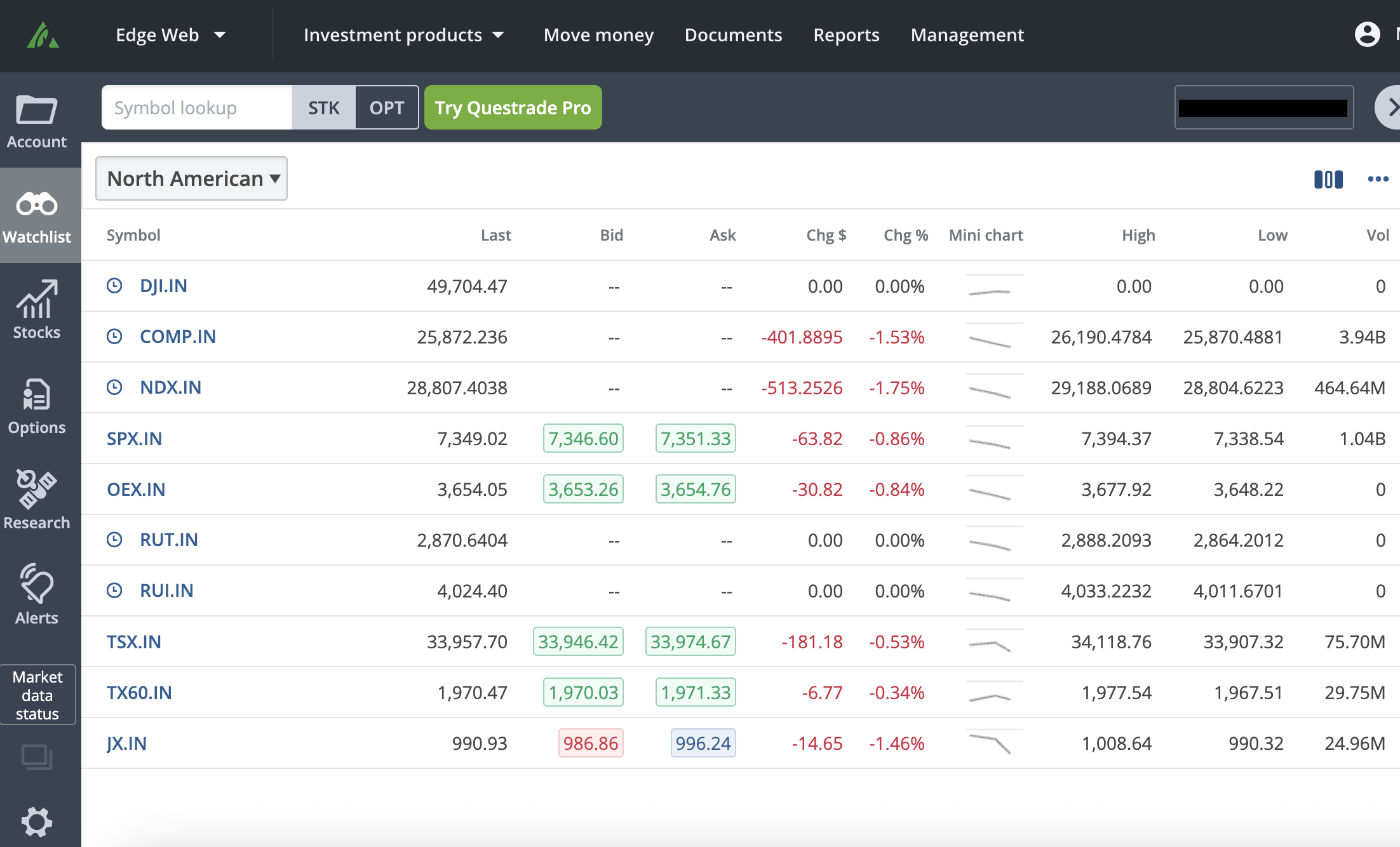
Web platform: Qtrade’s web platform is modern, logically structured, and has won design awards. Questrade's web platform is functional but slightly less intuitive — it has improved, but it still feels like two different products awkwardly joined (standard Questrade and Questrade Edge for advanced users). New investors might find Qtrade's web experience more welcoming but both are simple to learn how to use.
Mobile app: Questrade edges Qtrade here on raw ratings — 4.7/4.3 vs. 4.5/4.0 (iOS/Android), and Questrade's QuestMobile was rated #1 for mobile experience by Surviscor in 2025. Both apps are fully functional. The gap is not dramatic though.
Who loves Questrade: Investors who want to stay entirely in the mobile app and are comfortable with a slightly steeper learning curve on the web side. Questrade Edge appeals to more experienced traders who want more customisation.
Who loves Qtrade: Investors who primarily use the web platform, value a clean and guided experience, and want research tools immediately accessible without hunting through menus.
Which Offers Better Account Types?
Winner: Questrade — 12/13 vs. Qtrade's 10/13. But unless you need an RDSP, a LIF, or a corporate account, both of these brokers will have you covered. The vast majority of users shouldn’t worry about this category of the review.
Which Has Better Research and Tools?
Qtrade wins convincingly. Both brokers offer Trading Central, but Qtrade's integration is deeper, with a Portfolio Score tool (rates your portfolio on diversification, risk, and income metrics), a Portfolio Simulator, and a more comprehensive screener suite. The overall research environment is purpose-built for investors who want to analyse before they act.
Questrade integrates TipRanks, Seeking Alpha, and Trading Central. These are genuinely useful third-party tools, but they're bolt-ons rather than a native analytical environment. Questrade's research suite is good; Qtrade's is excellent.
For pure charting, Questrade Edge gives experienced users a more customisable workspace. For investors who want a guided, comprehensive view of their portfolio's health, Qtrade is ahead.
Which Has Better Customer Service?
This is legitimately close — both have strong reputations relative to the Big Banks.
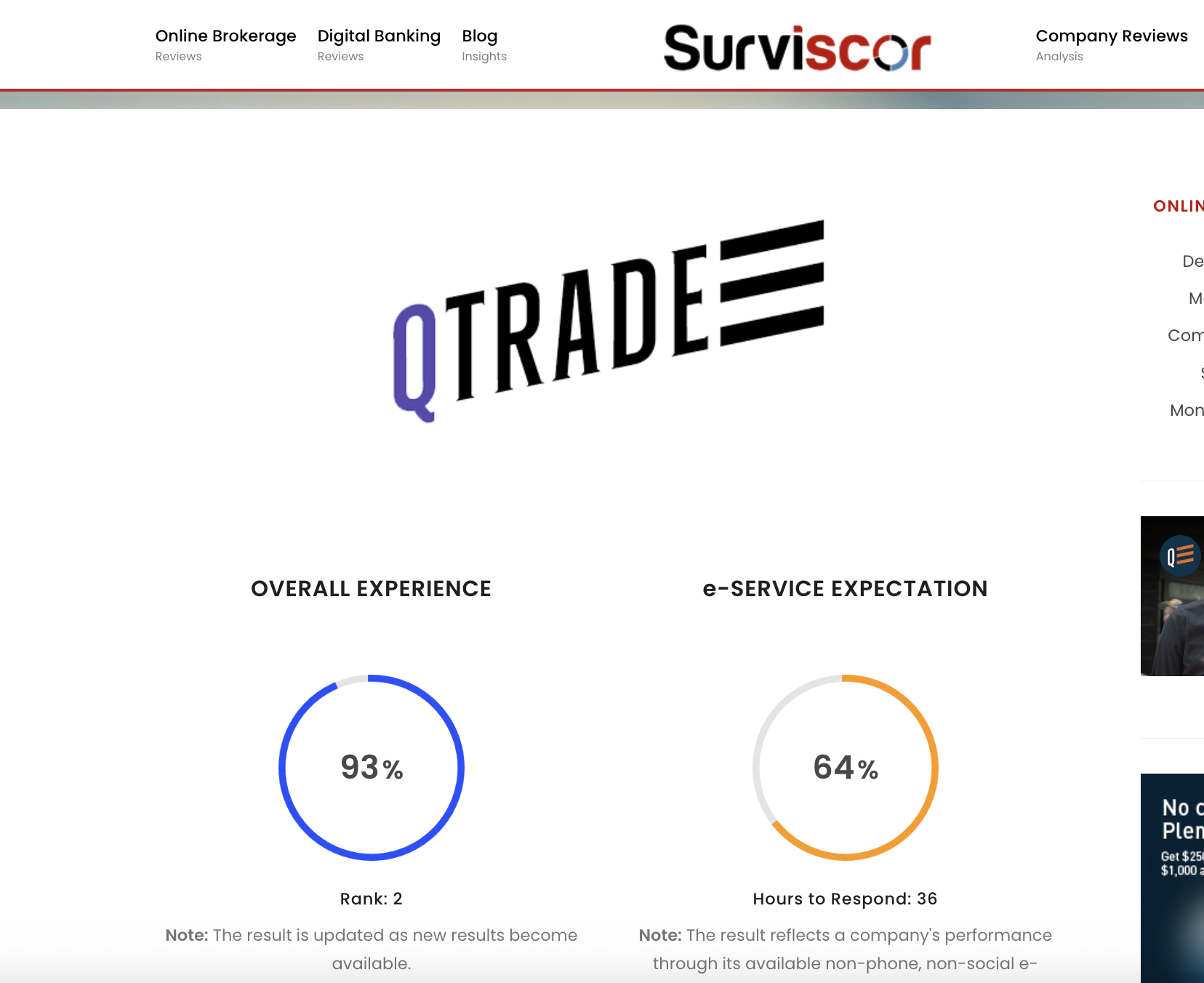
Questrade holds the Surviscor #1 service ranking for 2026, a third-party benchmark that's the most credible measure of Canadian brokerage service quality. Questrade's phone and live chat are consistently cited as fast and knowledgeable.
Qtrade has an industry-best reputation for dedicated phone support and consistently scores near the top of Surviscor's service rankings year over year. Its support team handles complex queries (options, Norbert's Gambit, account transfers) with more expertise than most.
Slight edge: Questrade based on the 2026 Surviscor ranking. In practice, most investors will find both acceptably excellent.
Is Qtrade or Questrade Safer?
Both are equally safe from a regulatory and insurance perspective.
Both are registered with the Canadian Investment Regulatory Organization (CIRO) — the national self-regulatory body overseeing investment dealers — and both are members of the Canadian Investor Protection Fund (CIPF), which covers up to $1,000,000 per account category if a member firm becomes insolvent. By the way, CIPF covers you if the firm fails, not if your investments decline in value. This is a distinction worth understanding.
Neither Qtrade nor Questrade has a material regulatory history that would raise concern for a standard retail investor. Questrade, as a larger, older firm (est. 1999), has more public regulatory history by volume — but nothing that materially distinguishes it from Qtrade for the purposes of choosing between the two.
Qtrade vs. Questrade: Which Should YOU Choose?
Beginners
Winner: Qtrade. The platform is slightly more intuitive, the research tools are more educational (Portfolio Score, simulator), and customer support is consistently rated excellent. Questrade is not a bad choice for beginners, but Qtrade's design removes friction at every step.
Read our full Qtrade review for a deeper breakdown of the onboarding experience.
Buy-and-Hold Investors
Winner: Tie. If you're building a long-term ETF or dividend portfolio, both platforms offer $0 commissions which makes them equivalent on transaction costs.
For our full analysis of each broker's long-term investing tools, see the Qtrade review and Questrade review.
Active Traders and Options Sellers
Winner: Qtrade. The per-contract rate ($0.75 vs. $0.99) is 24% cheaper. At any meaningful volume, that adds up to hundreds of dollars annually. Qtrade's margin rates are also far lower than Questrade's for accounts using leverage. The one caution: Qtrade's $30 flat options assignment fee is a real cost for covered call writers who get assigned frequently — account for it.
See our full compare page for how both rank against IBKR, which beats both on per-contract options pricing.
US-Stock Investors
Winner: Questrade. Questrade's dual-currency USD registered accounts are available in all registered account types with no monthly maintenance fee. Qtrade's USD registered account charges US$15/quarter unless you qualify for Investor Plus. If you're holding significant US-listed positions inside a TFSA or RRSP and want to avoid repeated FX conversion, Questrade's structure is cleaner.
Read the Questrade review for a full breakdown of the USD account mechanics.
————
Frequently Asked Questions
Can I transfer from Questrade to Qtrade (or vice versa)? Yes. Both brokers accept incoming transfers from competing institutions and will typically reimburse transfer-out fees charged by the sending broker, up to a limit, during promotional periods. Verify current reimbursement offers directly with the receiving broker before initiating — these limits change. Expect a transfer to take 5–10 business days via the standard ATON process.
Do Qtrade and Questrade charge the same fees? Not exactly. Both now charge $0 for stock and ETF commissions. Options pricing differs: Qtrade charges $0.75/contract vs. Questrade's $0.99/contract. Margin rates differ substantially — Qtrade charges Prime + 0–1%; Questrade charges approximately 11.5% (USD) for margin borrowing. Qtrade charges a $30 flat options assignment fee; Questrade does not appear to charge one. Verify both fee schedules at Qtrade's fee page and Questrade's fee page.
Which has the better sign-up promo: Qtrade or Questrade? Qtrade by a wide margin. As of May 2026, Qtrade offers up to $5,000 in cash back and unlimited free trades (tiered by deposit size). Questrade offers $50 cash for a $250 deposit via affiliate link, plus up to $150 in transfer-in rebates active through June 30, 2026. Qtrade's promo is substantially better for any investor depositing a meaningful sum. Always verify current offers directly before opening — promotional terms change frequently.
Can I have accounts at both Qtrade and Questrade? Yes. There is no regulatory restriction on holding accounts at multiple brokers. Some investors use Questrade for USD registered accounts and Qtrade for research-heavy equity analysis. The downside is administrative — tracking two sets of tax slips, contribution room, and margin across two accounts adds complexity.
Which is better for a TFSA? For most TFSA investors: Qtrade. The platform, research tools, and DRIP support make it a better long-term home. If you hold significant US-listed positions inside your TFSA and want to avoid FX conversion entirely, Questrade's dual-currency TFSA (with no monthly fee) is more cost-efficient. Read our compare page for the full TFSA breakdown.
Which is better for an RRSP? Same split as the TFSA answer. Qtrade for most investors. Questrade for US-heavy portfolios where avoiding FX spreads inside the registered account is a priority — Questrade's RRSP USD account carries no monthly fee, while Qtrade's charges US$15/quarter unless you qualify for Investor Plus.
What are the hidden fees at Qtrade vs. Questrade? At Qtrade: the USD registered account fee (US$15/quarter below Investor Plus threshold) and the $30 flat options assignment fee are the two costs that catch investors off guard. At Questrade: ECN fees on certain order types are the main gotcha — technically free commissions, but market orders that remove liquidity from ECN-connected exchanges can incur small per-share fees. Neither broker charges account transfer-out fees in most circumstances, but verify before initiating a transfer.
Which is better for an FHSA? Both offer the First Home Savings Account. No meaningful difference in FHSA functionality between them. The overall platform quality at Qtrade makes it the slight preference, but this is a thin margin.
