Best Platform for Day Trading in Canada (2026)
Day trading in Canada is legal, has no pattern day trader rule like the U.S., and requires no special licence. But the broker you pick, the account type you use, and how you handle taxes will determine whether it's a viable strategy or an expensive mistake. Here's the complete setup.
What Makes Day Trading in Canada Different from the U.S.?
The single biggest structural advantage for Canadian day traders: there is no pattern day trader (PDT) rule. In the U.S., FINRA requires traders to maintain a minimum USD $25,000 account balance to execute four or more day trades within five business days. Canada has no such restriction. You can make as many intraday trades as you want, regardless of your account size.
That's where the good news ends. Canada's tax treatment of day trading profits is less forgiving than most beginners expect, and the broker landscape - while improving - still has fewer options optimized for high-frequency intraday execution compared to the U.S. market.
All Canadian brokerages are regulated by CIRO (the Canadian Investment Regulatory Organization, formerly IIROC), and client assets are protected up to $1 million per account category by CIPF.
Which Broker Is Best for Day Trading in Canada?
Three brokers stand out, each serving a different type of day trader. The right choice depends on your volume, strategy complexity, and how much platform horsepower you need.
Interactive Brokers - Best Overall for Serious Day Traders
Interactive Brokers is the default choice for anyone day trading in Canada with real volume. No other Canadian-accessible broker matches its combination of execution speed, market access, and cost structure for active traders.
Why IBKR wins for day trading:
Lowest margin rates in Canada - approximately 3.8–5.8% (benchmark + 0.5–1.5%), compared to prime + 1.25–2.5% at Big Bank brokerages. If you're trading on margin, this alone can save thousands per year.
Tiered per-share commissions - as low as $0.005/share USD or $0.01/share CAD, with volume discounts. No base fee on options ($0.15–$0.65 per contract, volume-tiered).
Trader Workstation (TWS) - institutional-grade platform with 100+ order types, direct routing, programmable trading via API, Level II data, and advanced charting. The newer IBKR Desktop adds a more modern interface with multisort screening and an option lattice tool.
Nearly 24/6 extended-hours trading for U.S. stocks - the most extensive window available in Canada.
150+ global exchanges - if your strategy involves international markets, no Canadian competitor comes close.
Best-in-class FX conversion - approximately 0.002% + $2 per conversion, versus 1.5% at most competitors. Critical if you're trading U.S.-listed equities.
The trade-off: IBKR has a steep learning curve. The platform is built for professionals and it shows. Account opening + funding takes up to 7 days, and it offers fewer registered account types than other brokerages (no RESP, LIRA, LIF, or RDSP). For a deeper look, read our Interactive Brokers review.
Questrade - Best for Active Retail Traders
Questrade occupies the middle ground: commission-free stock and ETF trading since February 2025, a capable platform with advanced tools, and none of IBKR's complexity.
Why Questrade works for day traders:
$0 commissions on stocks and ETFs - ECN fees may still apply, but the headline cost is zero.
Options at $0 base + $0.99 per contract - competitive, though not as cheap as IBKR at volume or Wealthsimple at $0.
Questrade Pro and IQ Edge - the desktop platform offers Level II data, advanced charting, direct routing, and TipRanks/Seeking Alpha/Trading Central research integration. Overnight trading was added recently.
Dual-currency registered accounts - hold USD natively in your TFSA or RRSP without forced conversion.
Customer support ranked #1 in the Surviscor 2026 service review.
The trade-off: Margin rates are high (~11.5% USD), which makes leveraged strategies expensive compared to IBKR. The FX spread is 1.5% unless you use Norbert's Gambit. For more detail, see our Questrade review.
Wealthsimple - Best Entry Point for New Traders
Wealthsimple is the most accessible on-ramp, but it has real limitations for serious day trading.
Why beginners start here:
$0 commissions on everything - stocks, ETFs, and uniquely, $0 per-contract options fees (the only broker in Canada offering this as of January 2026).
Account opens in under 10 minutes with instant deposits up to $50K.
24/5 extended-hours trading for U.S. equities.
Fractional shares down to $1 on both CAD and U.S. stocks.
The only Canadian broker offering direct crypto trading alongside equities.
The trade-off: Minimal charting and research tools, no Level II data, no direct routing, no API access, and no advanced order types. The 1.5% FX spread on the free tier eats into U.S. equity profits (drops to 0.05% on Premium/Generation tiers at $100K+). Wealthsimple's synthetic DRIP and limited platform depth make it better for testing the waters than for executing a refined intraday strategy. See our Wealthsimple review for the full picture.
How Do These Brokers Compare for Day Trading?
For a full breakdown of all Canadian brokerages, check our complete comparison table.
Which Account Type Should You Day Trade In?
This is where Canadian day traders get into trouble. The account you choose has massive tax implications.
Margin Account (Non-Registered) - The Standard Choice
A non-registered margin account is the default for day trading. It gives you access to leverage (borrowed funds), short selling, and the full range of order types. There are no contribution limits and no CRA restrictions on trading frequency.
The downside: all profits are taxable. And if the CRA classifies your activity as business income (more on that below), 100% of gains are taxed at your marginal rate - not the 50% capital gains inclusion rate.
TFSA - Day Trading Not Allowed, Use with Extreme Caution
The TFSA's tax-free growth is tempting, but the CRA actively audits TFSA accounts that show high-frequency, short-term trading patterns. If the CRA determines your TFSA activity constitutes carrying on a business, the tax-free status is revoked for those profits, and they're reassessed as taxable business income - potentially with interest and penalties.
There is no published trade-count threshold for what constitutes ‘day trading.’ The CRA evaluates a combination of frequency, holding periods, trading knowledge, time spent, and whether the activity resembles a commercial operation. Day trading in a TFSA is, functionally, a gamble on not getting audited. The risk-reward math is bad.
RRSP - Slightly Safer, Still Risky

Unlike TFSAs, RRSPs are not typically taxed on internal trading activity as long as you hold qualified investments and stay within contribution limits. However, similar CRA scrutiny can apply if your RRSP trading is aggressive enough to resemble a business operation. And withdrawals are always taxed as income, so there's no free lunch.
FHSA and RESP - Don't Even Think About It
Day trading inside an RESP can cause the plan to lose its registered status, forcing repayment of government grants and triggering a 20% penalty tax. The FHSA is too new for definitive CRA guidance, but based on the agency's treatment of other registered accounts, active trading is a risk not worth taking.
The practical answer: day trade in a margin account. Use your TFSA and RRSP for long-term, buy-and-hold investing.
How Does the CRA Tax Day Trading Profits?
The CRA doesn't have a formal definition of "day trading." Instead, it evaluates your overall trading behaviour to classify profits as either capital gains or business income.
Capital gains treatment: 50% of your gain is included in taxable income. A $100,000 profit means $50,000 is taxed at your marginal rate. Capital losses can only offset capital gains.
Business income treatment: 100% of your gain is taxable. That same $100,000 profit is fully taxed. However, you can deduct trading-related expenses - commissions, data subscriptions, software, equipment, and even a portion of your internet bill - against business income. Business losses can offset other income.
The CRA uses several factors to determine classification: how frequently you trade, how long you hold positions, whether trading is your primary income source, your level of market knowledge and sophistication, and whether you use leverage. Daily trading almost always triggers business income treatment.
Consult a tax professional who understands active trading before your first tax filing as a day trader. The cost of getting this wrong dwarfs any accounting fee.
What About the 30-Day Superficial Loss Rule?
This deserves its own callout because it catches day traders constantly. If you sell shares of, say, Royal Bank at a loss on Monday and buy them back on Tuesday, that loss is disallowed. It gets added to your adjusted cost base of the repurchased shares, effectively deferring the loss - but not eliminating your tax on other gains in the current year.
For day traders who repeatedly trade the same handful of names, this rule creates a record-keeping nightmare and can inflate your effective tax bill. Track every trade meticulously, and consider using different securities or ETFs to avoid triggering the rule when tax-loss harvesting.
What Do You Actually Need to Start Day Trading in Canada?
Strip away the marketing and course-selling noise, and the practical requirements are straightforward:
A margin account at a broker with competitive commissions, reliable execution, and tools that match your strategy. IBKR for professionals, Questrade for active retail, Wealthsimple to learn the mechanics.
Enough capital to absorb losses. There's no legal minimum in Canada, but starting with less than $10,000-$25,000 in a margin account limits your ability to manage risk and size positions meaningfully. Most experienced day traders recommend not trading with money you can't afford to lose entirely.
A data and charting setup. Level II market data, a screener, and real-time charting are table stakes for any strategy beyond basic momentum plays. IBKR includes much of this; Questrade offers it through IQ Edge; Wealthsimple does not.
A tax professional who understands business income treatment for active traders. Set this up before you start - not at tax time.
Emotional discipline and a written trading plan. This isn't broker advice, but it's the most honest thing anyone can tell you: the majority of retail day traders lose money. The platform and account setup only matter if your strategy and risk management are sound. Day trading is definitely not for everyone.
The Bottom Line
The best setup for day trading in Canada in 2026 is an Interactive Brokers margin account if you're serious about it - nothing else in the Canadian market matches its execution quality, margin rates, and platform depth for active traders. Questrade is a strong second choice for traders who want commission-free equities with more tools than Wealthsimple offers. And Wealthsimple is a reasonable starting point if you're testing day trading strategies with smaller capital and want zero-friction onboarding.
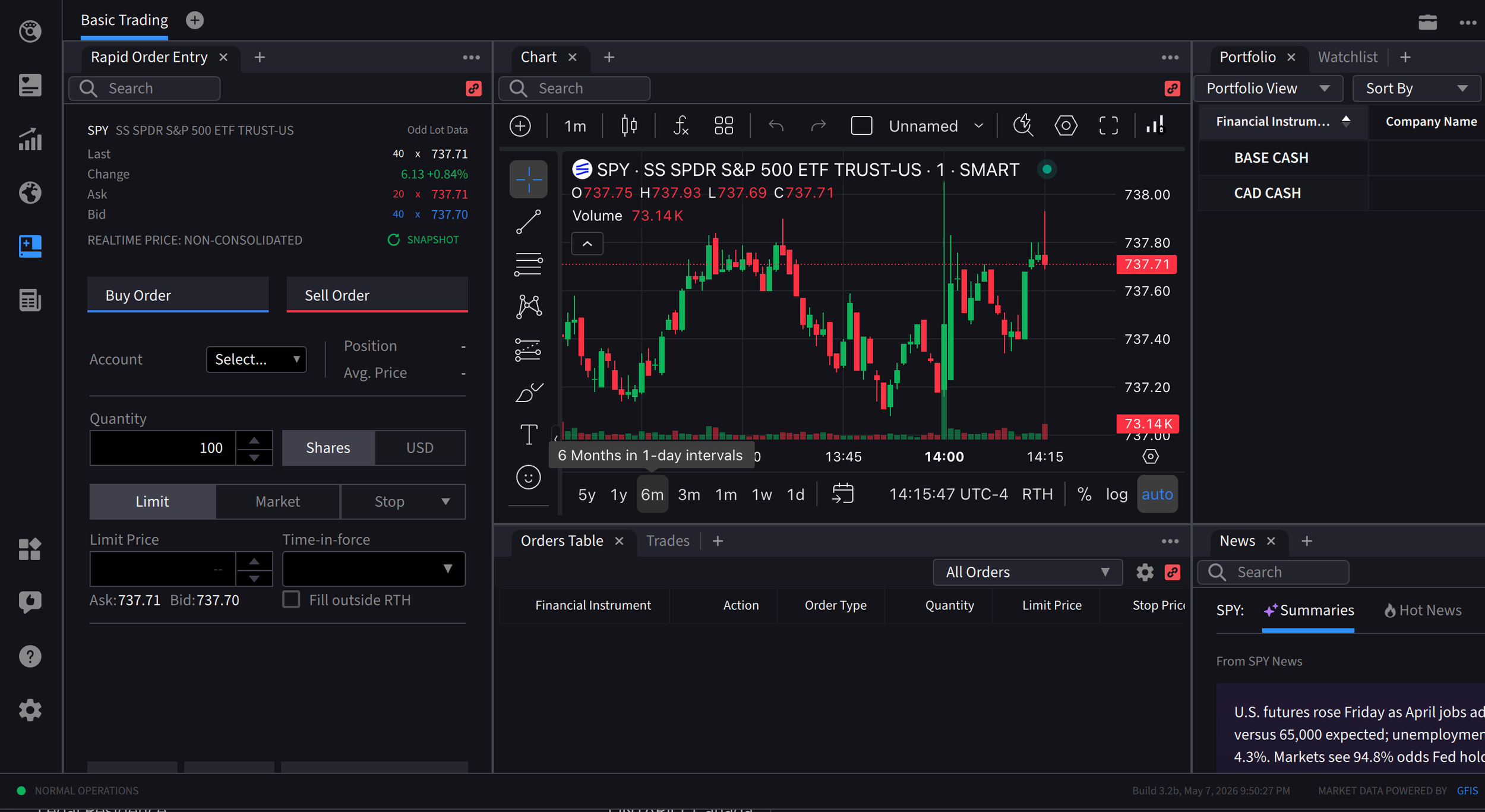
IBKR basic trading view on desktop app.
Whichever broker you choose, trade in a non-registered margin account - not a TFSA or RRSP. Assume the CRA will classify your activity as business income, track every trade, and get a tax professional involved early.
For current sign-up offers at each broker, visit our sign-up bonuses page. And if you're still deciding which brokerage fits your needs overall - not just for day trading - our guide to choosing a Canadian online broker covers the full decision framework.
Broker Guide Canada may earn a commission through affiliate links. This does not influence our editorial rankings. See our full disclosure.
