RESP Investing in Canada: Rules, Grants, and Where to Open One
An RESP (Registered Education Savings Plan) is a tax-sheltered account that lets you save for a child's post-secondary education - and the federal government kicks in up to $7,200 in free grant money through the CESG. It is the single highest-return investment most Canadian parents can access for their children’s benefit. In this article we’ll explain why you should start an RESP as soon as possible and we’ll show you how to max out that free government grant money. Everybody loves free money.
How Does an RESP Work?
You open an RESP and name a beneficiary (your child, grandchild, niece, nephew - any Canadian resident with a SIN). You contribute after-tax dollars. The money grows tax-free inside the account. When the beneficiary enrols in a qualifying post-secondary program, withdrawals of investment growth and grants (called Educational Assistance Payments, or EAPs) are taxed in the student's hands - and since most full-time students earn very little, the effective tax rate is usually zero.
Your original contributions come back to you tax-free at any time. You already paid tax on that money.
What Is the CESG and How Much Is It Worth?
The Canada Education Savings Grant (CESG) is a 20% government match on the first $2,500 you contribute EACH YEAR, per beneficiary, for a maximum of $500 per year and $7,200 over a lifetime. This money is available to all families, regardless of household income.
So, if you contribute at least $2,500 per year for 14 years, you’ll get $7,000 in grants. And in the 15th year, you can max out with the final $200 by depositing at least $1000.
Another key point is that if you have unused CESG deposit room from previous years, you can carry it forward. The government will match up to $5,000 in contributions in a single year (yielding $1,000 in CESG), so it is possible to catch up - just not all at once. This means that, even if you have a year where you can’t contribute the $2,500, you haven’t lost the opportunity to max out the government grant money. That said, the earlier you deposit and invest the money, the more time the account has to compound and grow.
By the way, you do not need to apply separately to the CESG - your RESP provider handles the grant application automatically when you contribute. The grant money will automatically be deposited into the RESP at some point early in the following year.
Families with lower household net income may qualify for the Additional CESG, which boosts the match rate to 30% or 40% on the first $500 contributed. There is also the Canada Learning Bond (CLB), which provides up to $2,000 in free money for children from low-income families, with no personal contribution required.
The CESG alone represents an instant, guaranteed 20% return on your first $2,500. No stock, bond, or GIC in existence matches that. This is why the floor recommendation for every Canadian parent is: contribute at least $2,500 per year per child to capture the full grant.
What Are the RESP Contribution Limits?
There is no annual contribution limit. The lifetime contribution limit is $50,000 per beneficiary. However, only the first $2,500 contributed each year attracts the CESG match, so front-loading $50,000 on day one would forfeit most of the grant room. The optimal strategy for most families is $2,500 per year for 14.4 years, which collects the full $7,200 in grants and still leaves room for additional contributions if you have surplus cash.
Over-contributing beyond $50,000 triggers a 1% monthly penalty tax on the excess.
What Should You Invest In?
This depends entirely on the child's age - your time horizon.
Child aged 0 to 10: You have at least 8 years before the money is needed. A broadly diversified equity ETF (like XEQT, VEQT, or VGRO) is a reasonable core holding. Commission-free brokers make this painless to buy monthly.
Child aged 10 to 14: Start introducing fixed income. A balanced ETF (VBAL, XBAL) or a GIC ladder smooths volatility as you approach the withdrawal window.
Child aged 15 to 17: Capital preservation matters more than growth. High-interest savings ETFs (like CASH or PSA), GICs, or a conservative allocation fund should dominate. A 30% equity drawdown the year before tuition hits is not a risk worth taking.
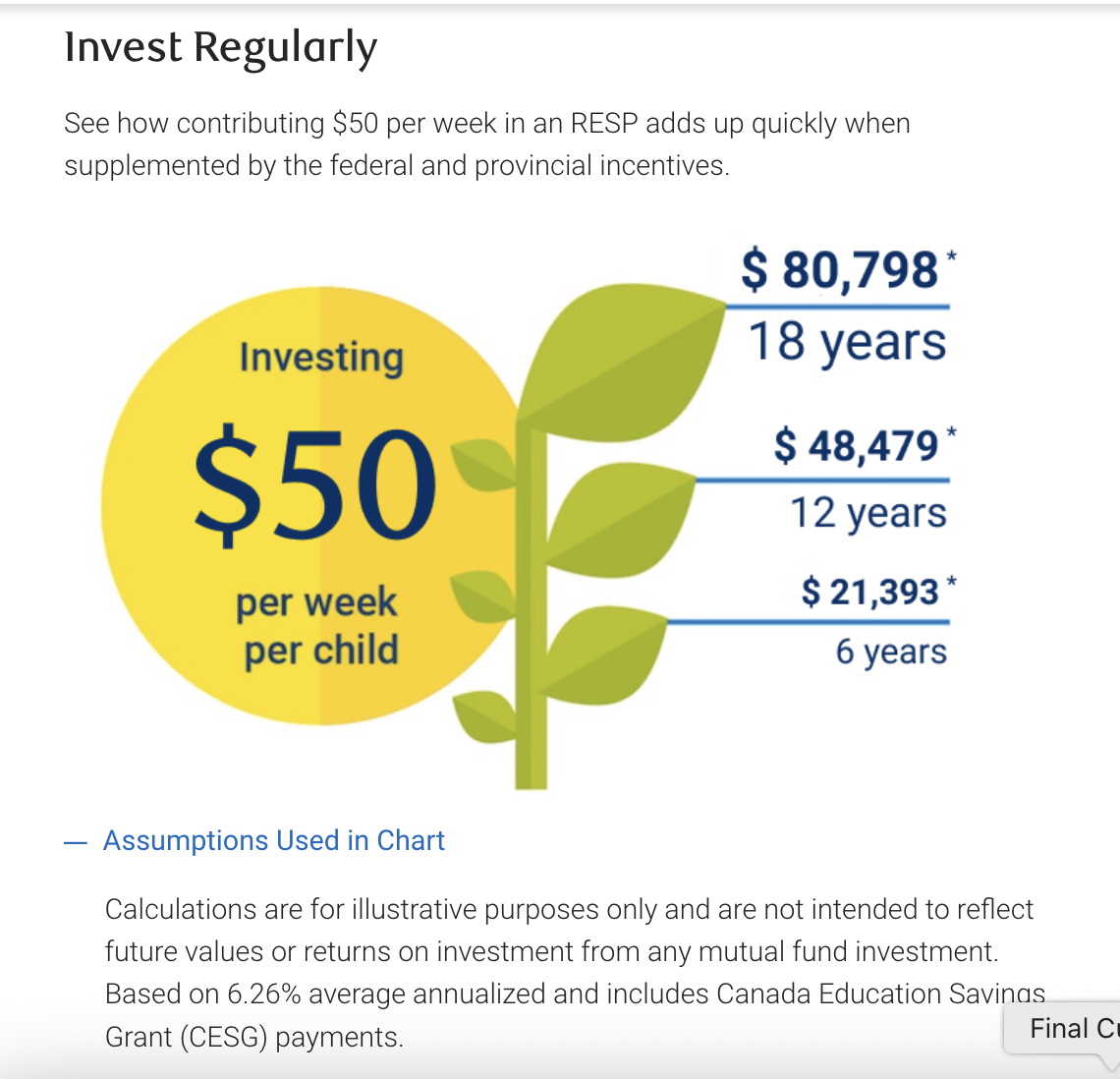
The worst thing you can do is leave RESP money in cash for 18 years. A $2,500 annual contribution earning 7% annually grows to roughly $85,000 over 18 years. The same contributions sitting in a savings account at 3% reach about $60,000. That $25,000 gap is real money - potentially a full year of tuition and living expenses.
Where Should You Open an RESP?
Not every broker offers RESPs. Interactive Brokers, Moomoo, and Webull do not support them. The Big Banks all do, but with $9.95 commissions per trade, they are expensive for a monthly-contribution strategy. The three strongest self-directed options for an RESP are:
Wealthsimple is the easiest choice for most parents. Zero commissions, fractional shares (so your $208.33 monthly contribution buys exactly that much of an ETF, no leftover cash), and an app that takes about 10 minutes to set up. Its lack of advanced research tools is irrelevant for an account where you are buying the same ETF every month. Read our full Wealthsimple review.
Questrade is the veteran pick. Commission-free trading, dual-currency USD accounts (useful if you want to hold US-listed ETFs without paying FX fees on every contribution), and stronger research tools via TipRanks and Seeking Alpha. A good fit if you want more control. See our Questrade review.
Qtrade went commission-free in October 2025 and has quietly become one of the best-designed platforms in Canada. Its Portfolio Score tool can help you gut-check your RESP allocation as the child ages. Check our Qtrade review.
For a side-by-side breakdown of all 12 brokers, see our full comparison table. And if sign-up bonuses factor into your decision, we keep a running list of current promotions.
Avoid group RESPs (also called scholarship trust plans) sold by companies like CST Consulting or Heritage Education Funds. These pool your money with other investors, lock you into rigid contribution schedules, charge high fees, and penalize you severely for early withdrawal. You’ll find these companies advertising aggressively at baby shows and events. A self-directed RESP at any of the brokers above gives you full control with lower costs.
What Happens If Your Child Doesn't Go to School?
You have options. Your contributions come back to you tax-free. The CESG grants get returned to the government. The investment growth can be rolled into your RRSP (up to $50,000 of room), where it is taxed as income but avoids the 20% penalty. If you have no RRSP room, the growth is paid out as an Accumulated Income Payment (AIP), taxed at your marginal rate plus a 20% surcharge.
You can also change the beneficiary to another eligible family member (a sibling, for example) without triggering any penalties or grant clawbacks.
The Bottom Line
Open a self-directed RESP at a commission-free broker. Contribute $2,500 per year to capture the full CESG. Buy a low-cost, broadly diversified ETF and shift to fixed income as the child approaches 15. That is the entire playbook. The 20% government match makes this the most efficient savings vehicle most Canadian families have access to, and leaving it on the table is leaving free money behind.
Broker Guide Canada may earn a commission through affiliate links. This does not influence our editorial rankings. See our full disclosure.
